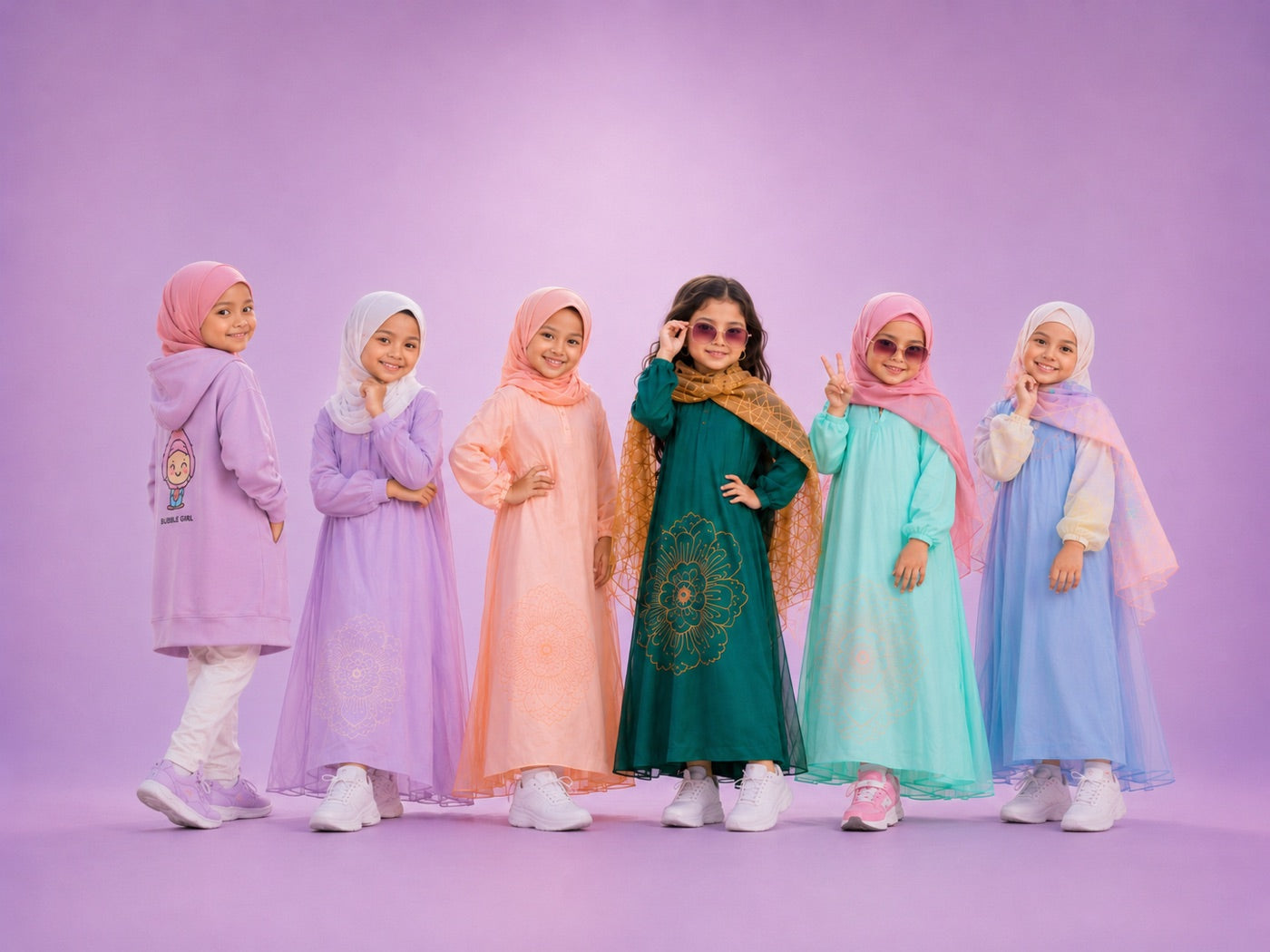
The Islamic authorities cited on this page tie the obligation to religious maturity, not to childhood, so a child before that point is generally described as not yet obliged. There is no single agreed age at which maturity begins. Many families introduce the hijab gently before then, as habit rather than obligation.
Last updated: 20 September 2026

Do children have to wear the hijab?
The scholarly bodies consulted for this page describe the obligation as beginning at religious maturity, which means a child before that point is not yet obliged. That is the position stated by Egypt's Dar al-Ifta, by SeekersGuidance and by the Yaqeen Institute, each of which ties covering to accountability rather than to a fixed age in childhood.
What follows from that is worth saying plainly, because it is the part parents most often get told the other way round. A young girl who wears a hijab to school is doing something her family has chosen to introduce. She is not late if she does not, and she is not failing if she takes it off again at eight and asks about it again at eleven.
This page reports what the practice is, what different positions exist and what parents commonly do. It does not tell you what your daughter must do. That decision sits with you, in conversation with your own scholar or community.
At what age does it begin?
There is no single agreed age, and any page that gives you one number is choosing a position rather than reporting the range.
The pattern across the sources is consistent on the principle and divided on the number. Sunni institutional answers tie the start of covering to signs of maturity rather than to a birthday. Within Shia Imami jurisprudence a specific age has long been the prevalent view, and that view is itself disputed among Shia jurists.
What the main positions say
What different Islamic authorities say about when covering begins
| Authority |
What it ties the start of covering to |
In its own words |
| Egypt's Dar al-Ifta |
The age of legal accountability |
"the age when a female first experiences menstruation and attains womanhood" |
| SeekersGuidance, answered by Shaykh Abdul Sami' al-Yaqti |
The age of moral responsibility |
"signs such as the onset of menstruation or other indications" |
| Yaqeen Institute, Dr Tesneem Alkiek |
Puberty |
cites the report that a woman who reaches puberty covers all but her hands and face |
| Shia Imami jurisprudence, as surveyed by Syed Ali Imran |
Contested within the tradition |
prevalent traditional view is nine lunar years; other jurists tie it to signs of puberty up to thirteen; "there has never been a consensus on this matter" |
| Before that point, across the Sunni sources above |
Habituation, not obligation |
guardians are advised to teach and encourage from "the age of discernment" |

Useful? Send this chart to a parent who has been told there is one fixed age.
Three things are worth taking from that table. The principle is shared: covering attaches to maturity, not to a birthday. The number is not shared, and the disagreement is old rather than modern. And every one of these authorities describes the years before maturity as a period of teaching, not of obligation.
If you want a single sentence to hold on to: the question is not what age she should start, it is whether she has reached the point her family's tradition treats as maturity, and what you do in the years before that.
What the Quran says
Two passages are the ones the sources return to. Surah An-Nur 24:31 instructs believing women to lower their gaze, guard their modesty, and "wrap their headcovers over their chests". Surah Al-Ahzab 33:59 instructs the Prophet to tell the women of the believers to draw part of their outer garments over themselves.
For the verses, the classical readings and the wider concept of modesty in Islam, the fuller treatment is in our post on what the Quran and hadith say about modesty.
Why many families start earlier
Because teaching is not the same as obliging, and every source above draws that line.
The reasoning most often given runs by analogy with prayer. Guardians are advised to begin instructing a child from around the age of seven, described as the age of discernment rather than the age of accountability, so that the practice is familiar by the time the obligation attaches. The Mufti of the Federal Territory of Malaysia puts the purpose directly: children who have not reached maturity are not obliged, and the point of instructing them earlier is that they "be familiar with that practice". SeekersGuidance applies the same logic to covering, advising guardians to "train her in the hijab, habituate her to it, encourage her towards it" from the age of discernment.
Two practical notes on that, from parents rather than from the sources.
Starting early is not the same as starting permanently
A hijab worn for the school run and taken off at the gate is a normal stage, not a failure of the stage. Habituation is the stated purpose, and habituation is by definition partial before it is complete.
Choice framing is the part that lasts
Every source treats the eventual obligation as attaching to her, not to you. The conversations that hold up over ten years tend to be the ones where she understood early that this would become her decision. Our guide for girls covers this side of it, written to be read by her rather than about her: wearing hijab for the first time.
How to talk to your daughter about it
Start earlier than the conversation you are dreading, and make it smaller than you think it needs to be.

The most common mistake is treating this as one significant talk at one significant age. The families who find it easiest tend to have made it an ordinary, repeated, low-stakes subject: pointing out a hijabi character in a book, answering a question at the school gate, letting her try on a scarf at home with no expectation attached.
A few things that help.
-
Answer the question she asked, not the question you are worried about. "Why does Auntie wear that?" is a request for information, not the opening of a negotiation
-
Say the honest thing about the age. "There isn't one agreed age, and different families do it differently" is both true and reassuring. A specific number invites a countdown
-
Separate modesty from the scarf. Every source on this page describes modesty as covering behaviour, speech and conduct as well as dress. A girl who thinks the whole of it is a piece of cloth has been given the smallest version of it
-
Do not make it a reward or a punishment. Tying it to good behaviour makes it something that can be lost
-
Expect it to move backwards. Interest at seven, disinterest at nine, and a decision at twelve is a completely ordinary shape
For the longer version of this, with age-by-age conversation starters and the questions she is most likely to ask, see our guide to teaching your child about modesty and the hijab.
Uniform policy is set by the school, and Department for Education guidance expects schools to accommodate religious requirements where they reasonably can.

The current DfE guidance, Developing school uniform policy, states that it is for the governing board to decide the uniform policy, and that "it should be possible for most religious requirements to be met within a school uniform policy, and a governing board should act reasonably through consultation and dialogue in accommodating these." The DfE's separate advice on the Equality Act 2010 and schools says schools "should be sensitive to the needs of different cultures, races and religions and act reasonably in accommodating these needs, without compromising important school policies, such as school safety or discipline."
In practice that usually means a school will specify colour rather than refuse the item. A short email to the office before the first day, asking what colour is acceptable and whether a sports version is allowed for PE, resolves most of it before it becomes a conversation your daughter has to have in front of a class.
This is a summary of published guidance and not legal advice. If a school refuses outright, the route is the school's own complaints procedure first.
For the confidence side of school, which is the part parents underestimate, see staying confident wearing hijab at school.
If she is finding it hard
Take the practical causes off the table before you treat it as a crisis of faith, because most of the time it is a practical cause.
The complaints that get reported as "she doesn't want to wear it" are very often heat, slipping, headaches from a tight cap, being the only one in her year, or a style that suits a grown woman's face and not a nine-year-old's. Each of those has an answer that is not a conversation about belief.
If it is not practical, the thing that helps most is removing the sense that stopping is a verdict. A girl who believes taking it off means she has failed will keep wearing something she resents. A girl who understands she can stop, and revisit it, generally comes back to it on her own terms.
For styles that work on younger faces and hold without constant adjusting, see hijab styles for girls.
Choosing a first hijab
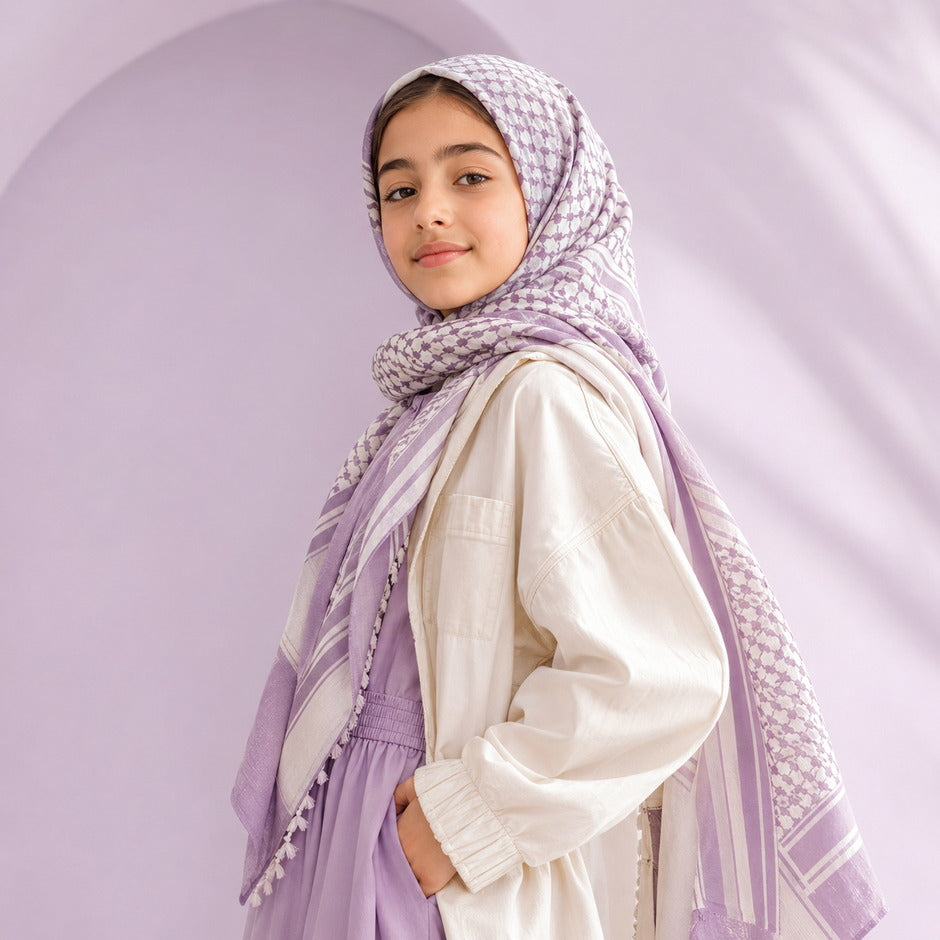
The first one should be easy to put on without help. That is the whole specification.
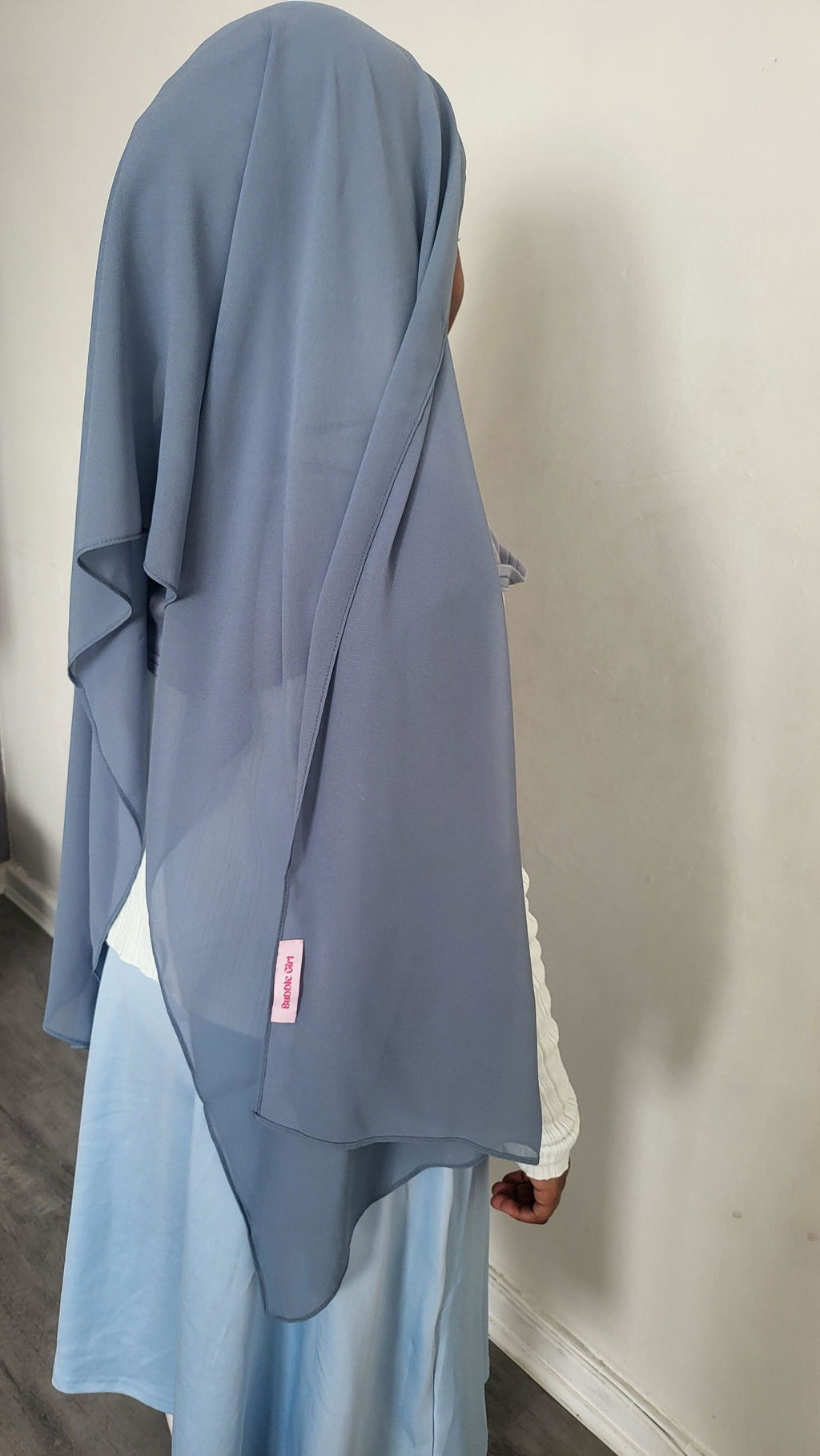
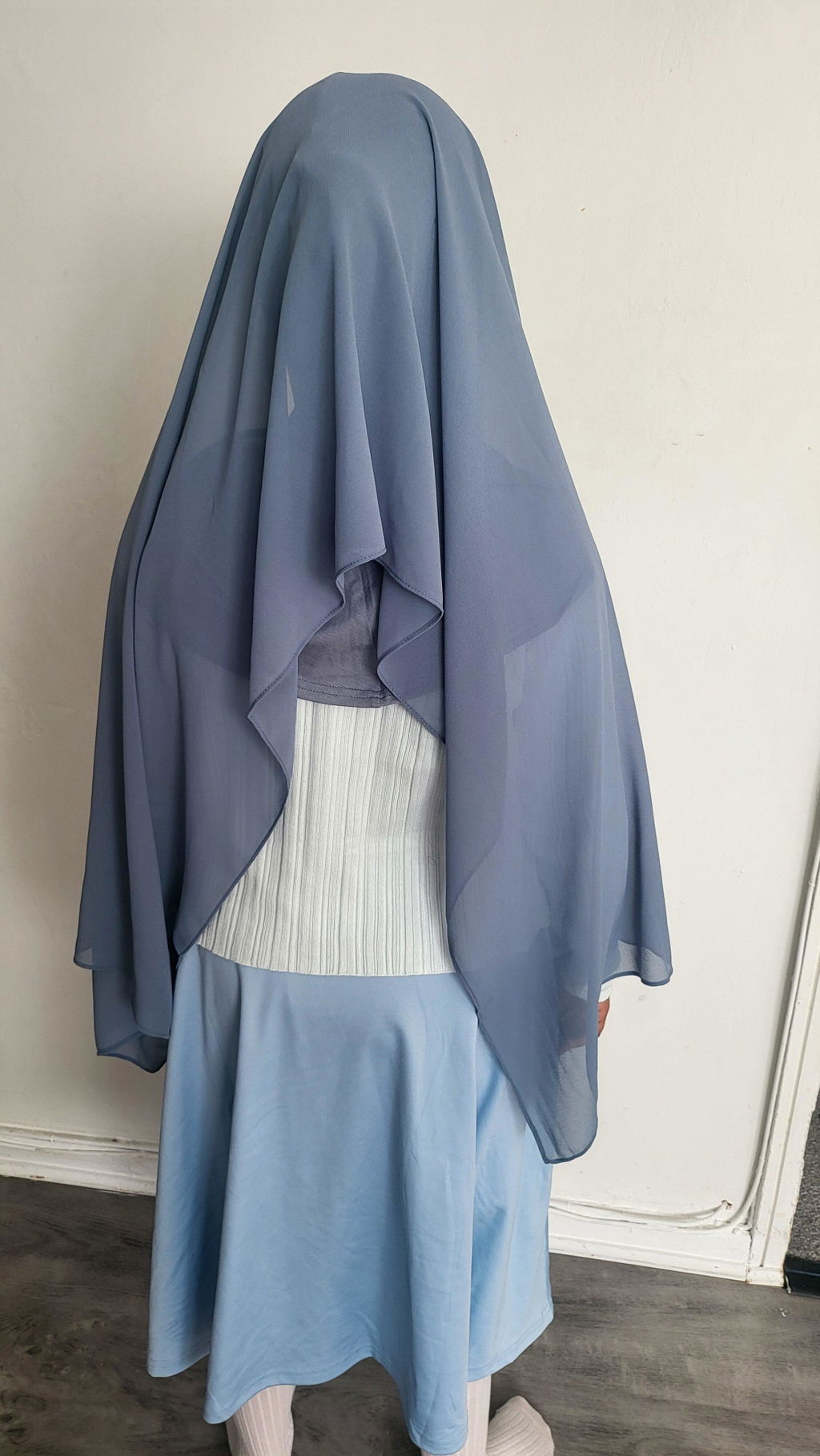
Most of what makes a young girl give up is friction: two pins, a cap that slides, a length she trips on. Instant styles remove the wrapping step entirely, which matters most in the first year and on school mornings.
New guides for parents, by email
We write these guides slowly and name our sources. When the next one is ready we will send it to you, along with 10% off a first order.
Use the newsletter box at the foot of this page to sign up.
Sources
- Egypt's Dar al-Ifta, The Ruling on Hijab in Islam, fatwa 23911, dated 16 November 2025. dar-alifta.org
- SeekersGuidance, answer by Shaykh Abdul Sami' al-Yaqti, Is It Permissible to Hold a Celebration for a Girl When She Wears Hijab? seekersguidance.org
- SeekersGuidance, answer by Shaykh Anas al-Musa, Is the Age of Seven Specifically the Age for Commanding Children to Pray?, 8 March 2025. seekersguidance.org
- Yaqeen Institute for Islamic Research, Dr Tesneem Alkiek, Is Hijab Religious or Cultural? How Islamic Rulings Are Formed, published 25 March 2021, updated 14 January 2026. yaqeeninstitute.org
- Syed Ali Imran, Legal Age of Bulugh for Girls, Al-Islam.org, Ahlul Bayt Digital Islamic Library Project. al-islam.org
- Jabatan Mufti Wilayah Persekutuan (Mufti of the Federal Territory, Malaysia), Al-Kafi #1368, 18 September 2019. muftiwp.gov.my
- Department for Education, Developing school uniform policy, last updated 6 July 2026. gov.uk
- Department for Education, The Equality Act 2010 and schools: departmental advice, May 2014.
Positions differ between and within schools of thought. This page reports the range rather than selecting from it. Parents decide, in consultation with their own scholar or community.
About Bubble Girl
Bubble Girl is a UK modestwear brand for girls aged 3 to 16. We make hijabs cut for younger heads and faces, and we write these guides because the questions parents send us are not answered anywhere they can easily find. We report what the sources say and we name them, so you can check.
Written by Nidda Tanvir, Bubble Girl. Last updated 20 September 2026.