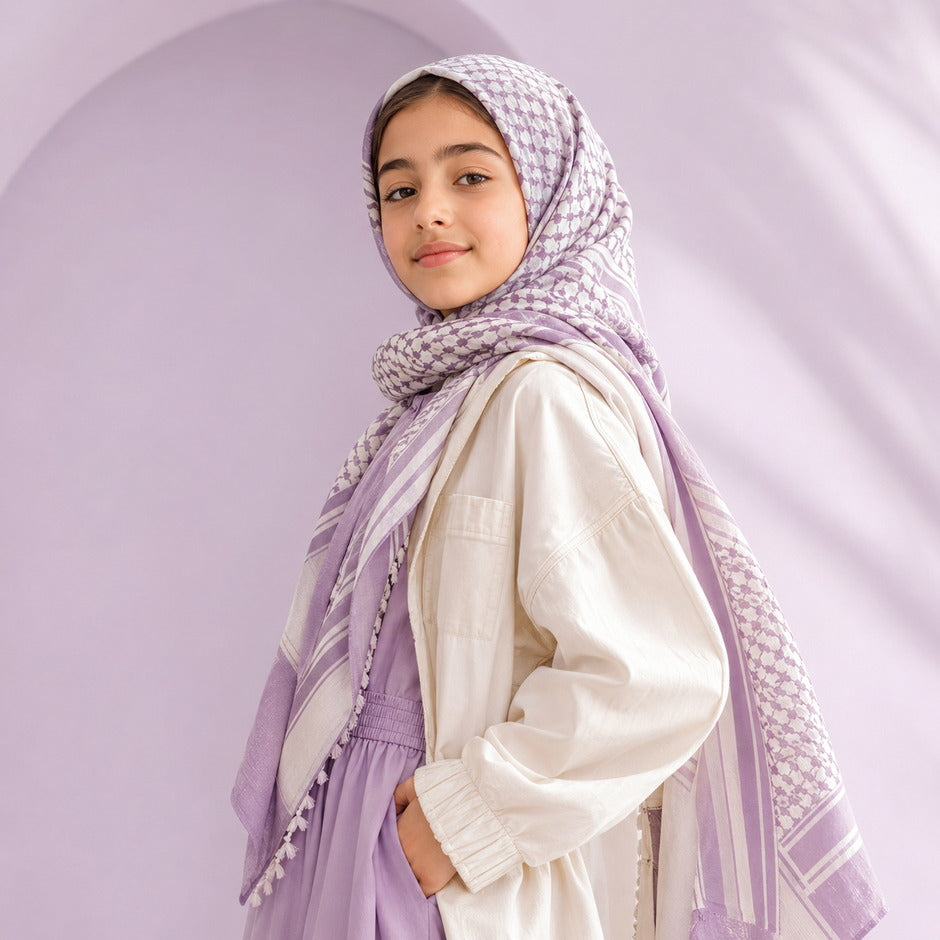
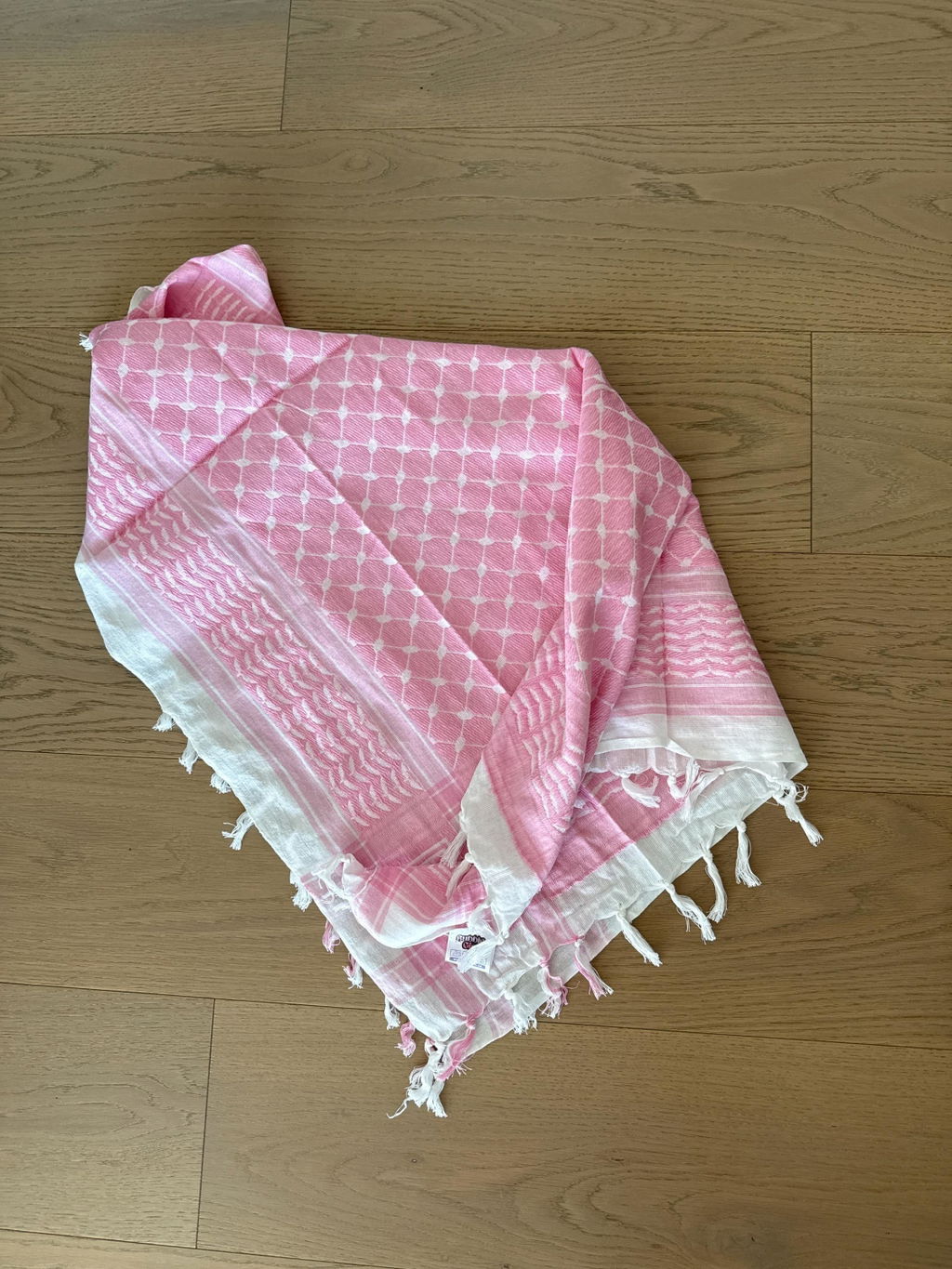
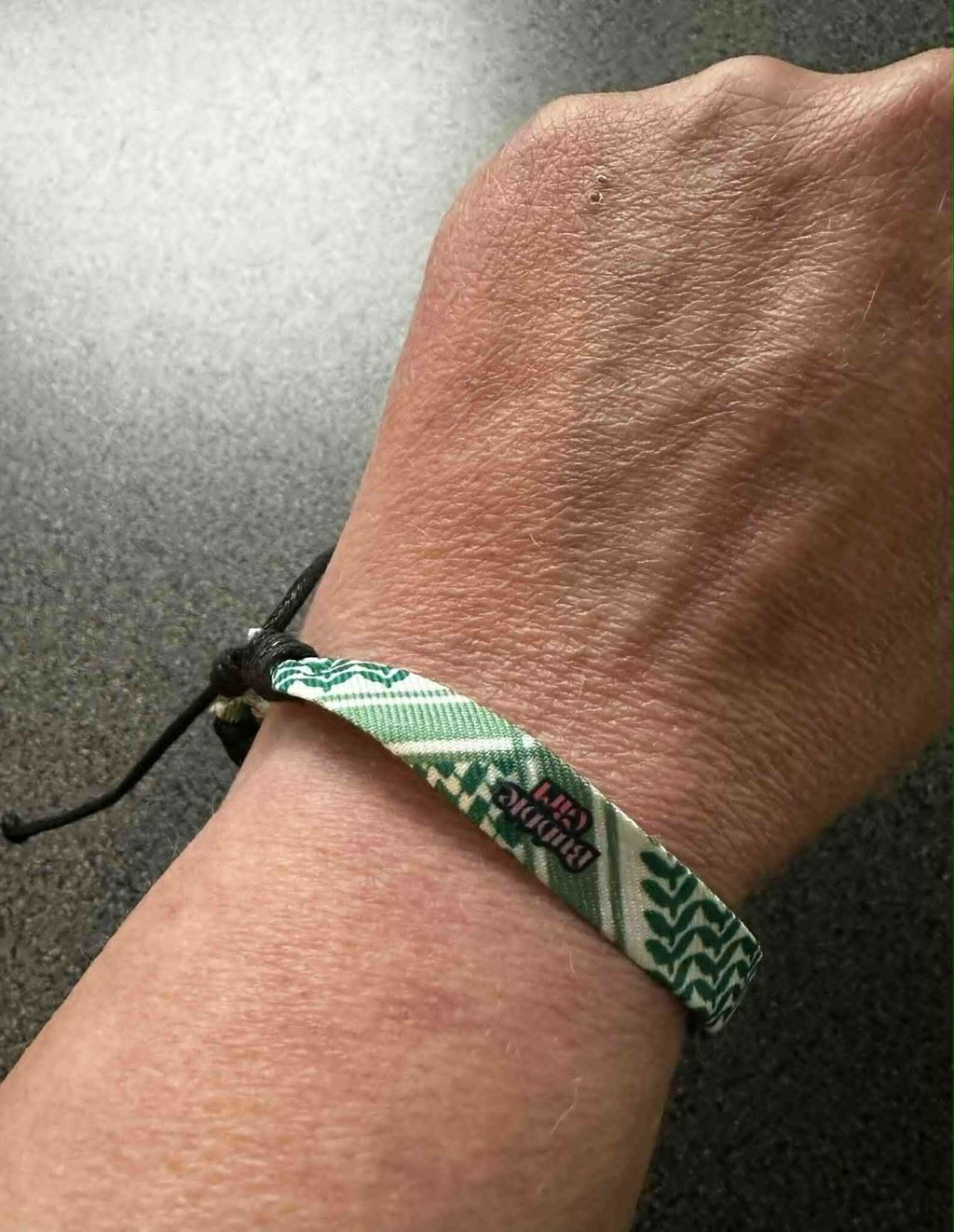
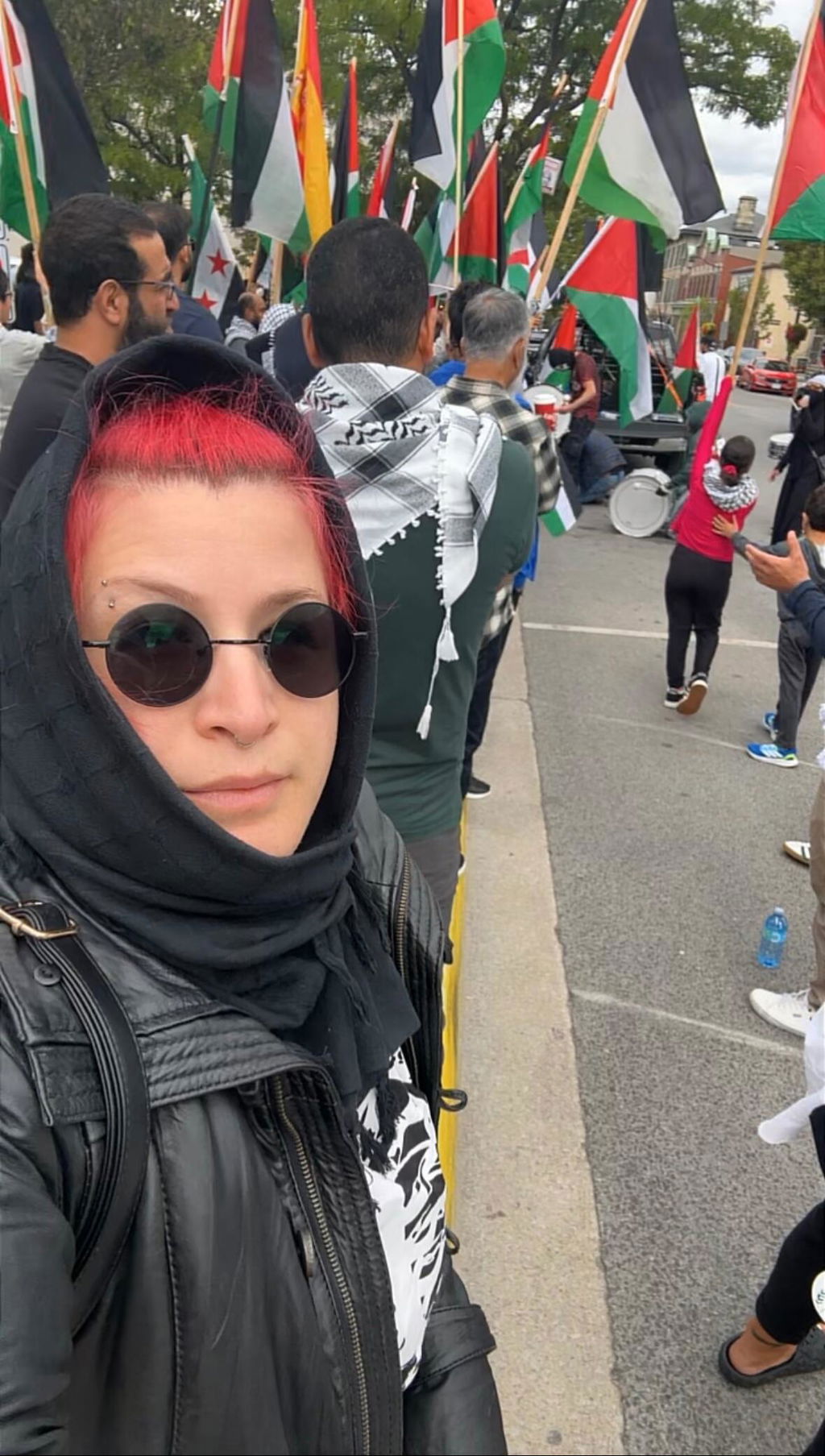
A keffiyeh is a square cotton scarf, about a metre across, folded diagonally into a triangle and worn over the head or around the neck. It is worn across the Arab world, and since the 1930s it has been the best known symbol of Palestinian national identity and, later, of solidarity with Palestinians. Depending on where you are it is also called a hatta, a shemagh or a ghutra. The chequered pattern is woven into the cloth rather than printed on it.
Looking for one to wear? Explore our Palestinian keffiyeh scarves, including traditional black and white, red and white and Bubble Girl's own woven colours.
Last updated: 20 September 2026
On this page
What is a keffiyeh?
A keffiyeh is a square of cloth, usually cotton, worn as a headdress.
The Victoria and Albert Museum describes it as “a metre-square piece of cloth, usually woven from cotton, with a distinctive black-and-white checked or houndstooth pattern”, worn “folded in half diagonally and held in place by a head-rope (‘agal)”. The American Heritage Dictionary gives the same shape: “a square of cloth, often embroidered, traditionally worn as a headdress by Arab men, either by winding it around the head or by folding it into a triangle, draping it over the head, and securing it with an agal”.
Two things are worth adding straight away, because both are usually left out.
The black and white version is not the only one, and not the oldest
Wafa Ghnaim, a research fellow at the Metropolitan Museum of Art and a curator at the Museum of the Palestinian People, records historic keffiyehs “woven from cotton, wool, or silk” in colours including “gold, purple, white, black, green, and red”. The anthropologist Ted Swedenburg records that before the 1930s the keffiyeh in Palestine was “usually pure white”. The black and white chequered cloth most people picture is a twentieth century form, not an ancient one.
It is not only Palestinian
The same garment is worn across the Levant, Iraq and the Gulf under different names, and has been for a long time. What is distinctly Palestinian is the black and white chequered form and what it came to stand for during the twentieth century.
What is the Palestinian scarf called?
A keffiyeh. In Palestinian Arabic it is usually called a hatta.
Beyond that the naming changes by region and by who is speaking.
What the same garment is called, and where
| Name |
Where the name is used |
Source |
| Keffiyeh, also spelled kufiya, kufiyya, kaffiyeh |
The usual English term |
Merriam-Webster gives the Arabic source forms as kūfīya, kaffīya
|
| Hatta, also hattah |
Palestine and the wider Levant |
Wafa Ghnaim; NPR; CNN |
| Shemagh |
Jordan and Syria, and commonly in Britain and Canada |
Middle East Eye for the regional use; Ted Swedenburg for the British and Canadian use, following British forces adopting the garment |
| Ghutra |
The Gulf states |
Middle East Eye |
| Palestinasjal, meaning “Palestinian scarf” |
Sweden, where solidarity wearing was widespread enough to give the garment its own name |
Ted Swedenburg |
| Chafiyeh |
Iran |
Encyclopaedia Britannica. Single source, so treat it as reported rather than established |
Is a shemagh the same thing as a keffiyeh?
Credible sources give three different answers, so this page reports the range rather than picking one.
Middle East Eye treats keffiyeh, shemagh and ghutra as regional names for one garment. Ted Swedenburg records shemagh as a term used particularly in Britain and Canada, after British forces adopted the garment during Second World War deployments in the Middle East. Saudipedia, published by the Saudi Ministry of Media, draws a different line again, and draws it inside a single country: it describes the shemagh as the red and white cloth and the ghutra as the plain white one, distinguishing them by colour rather than by region.
Where the word comes from
This is contested and the dictionaries do not agree. Merriam-Webster derives keffiyeh from “al-Kufa, town in Iraq”, and the American Heritage Dictionary gives the same derivation. Collins routes it instead through Late Latin cofea, the ancestor of the English word coif. Anyone telling you the Kufa derivation is settled has not looked at the second dictionary.
What the pattern means, and where each reading comes from
Less than you will usually be told.
Search for the meaning of the keffiyeh pattern and you will find the same three readings everywhere: the net stands for Palestinian fishermen and the Mediterranean, the repeated shapes are olive leaves for perseverance, and the bold border lines are trade routes. We went looking for the source of those readings and could not find one. No museum, no university, no textile institution and no encyclopaedia of record states them. The earliest versions we could find date from May 2021, and they spread widely from November 2023.
Meanwhile the people who actually weave the cloth use different names for the same designs.


The keffiyeh pattern: what it is called, and where each reading comes from
| The motif, and what the weavers in Hebron call it |
What it is usually said to mean |
What that reading rests on |
| The net across the field. Called the fatha, literally “opening” and popularly “fishnet” |
Palestinian fishermen and the Mediterranean |
No source of record. AramcoWorld’s 2018 reporting from Hebron attributes a net reading to “the fishermen of southern Mesopotamia”, not Palestine, hedges it as “said by some experts”, and records “honeycomb” and joined hands as competing readings |
| The repeated shapes in the field. Called the qamah, meaning wheat, in reference to Jericho |
Olive leaves, for perseverance and resilience |
No source of record. The earliest version we found is a Middle East Eye feature of 28 May 2021, where the reading is attributed to the novelist Susan Abulhawa rather than to a textile historian |
| The bold lines along the border. Not separately named in the sources we consulted |
Trade routes into and out of historic Palestine |
No source of record. Middle East Monitor reports it as “sometimes interpreted as” trade routes and offers a competing reading of a chain |
Useful? Send this to anyone who has passed on the fishnet and olive leaves story as fact.
None of this makes the popular readings worthless. People attach meaning to cloth, and a meaning a community took up in 2021 is still a meaning held by real people. What it does mean is that anyone writing “traditionally symbolises” or “has always represented” is claiming more than the record supports, and that the older, better attested names for those designs are the ones the weavers use.
The keffiyeh’s real meaning is not woven into the cloth. It was made in the twentieth century, by people, and it is documented.
Where the keffiyeh comes from
The documented history begins in the twentieth century. Almost everything you will read about what came before it is either folklore or silence.
See also the history of the keffiyeh.
The Sumerian origin story
You will often read that the keffiyeh began with Sumerian or Mesopotamian priests around 3100 BC. We could not find a single museum, archaeological publication, university or academic journal that supports it, and none of the accounts that repeat it cite an artefact, a relief, a text or an excavation. The most specific version, with the date attached, traces to one modern author writing without references, who calls the fishermen element a legend in her own text. The researcher Anu Lingala, quoted by Middle East Eye, puts the honest position plainly: “Its origins are open to speculation.”
What is documented: a peasant’s headdress
Until roughly the 1930s, wearing a keffiyeh in Palestine marked you as a Bedouin or a peasant rather than a townsman. Ted Swedenburg records that before the revolt the keffiyeh, “in those days usually pure white”, “marked its user as a fallah (peasant) or a Bedouin, that is, as a man who occupied an inferior position on the Palestinian Arab sociocultural hierarchy”. The urban middle and upper classes, he records, “distinguished themselves from those lower down on the social scale either by wearing the tarboosh (fez) or, if more modern-minded, by going bare-headed”. The Victoria and Albert Museum describes it in the same period as “the characteristic head-covering of the Bedouin, or Arab nomads”.
That is the starting point, and it matters for what happens next. The keffiyeh did not begin as a symbol of anything. It began as the cheap working headwear of the people at the bottom of the social order.
How it became a symbol of resistance
It became a national symbol during the Arab revolt against British rule in Palestine between 1936 and 1939, and it did so for a practical reason before a symbolic one: it hid the faces of the men fighting.

The revolt, 1936 to 1939
The historian Matthew Hughes, in Britain’s Pacification of Palestine, published by Cambridge University Press, describes the scene directly: “Kufiyyat hid the faces of the gunmen at the roadblock.” The Victoria and Albert Museum records that “the important role of peasant farmers (the fellahin) in the Great Arab Revolt of 1936 to 39” politicised the keffiyeh, and Ted Swedenburg dates its emergence as “a national sartorial symbol of Palestinian resistance” to that revolt.
In the summer and autumn of 1938, as guerrilla bands took control of a number of Arab towns, they ran a campaign to make urban men give up the tarboosh and put on the keffiyeh. Swedenburg gives the reasons as “to impose national unity in matters of dress as well as to compel a symbolic inversion of the social hierarchy”. NPR, reporting the same episode, gives a different reason: an order for men to wear it “to express solidarity with the revolutionaries and so that the British could not distinguish the fighters from others”. Both accounts are from credible sources and neither says the other is wrong, so we report both.
Either way, the effect was the same and it is the whole story of this garment in one move. A headdress that had marked you as a peasant became the thing a lawyer in Jaffa put on. It stopped being a class marker and became a national one.
Yasser Arafat
What made it global was one man wearing it for forty years.
Ted Swedenburg wrote in 1990 that “by making the kufiya his permanent headcovering”, the PLO chairman Yasser Arafat had nationalised it. The Victoria and Albert Museum puts it the same way: “Arafat’s use of the keffiyeh as his permanent head-covering cemented its status as a global icon of Palestinian nationalism and resistance.” Al Jazeera describes it as “the personal trademark” of the late Palestinian leader. He appeared on the cover of TIME wearing it in 1968, addressed the United Nations in it in 1974, wore it at the signing of the Oslo Accords and at the Nobel Peace Prize ceremony, and a keffiyeh was placed on his tomb in 2004.
You will very often read that Arafat folded his deliberately so that it fell in the shape of historic Palestine. Sources describe the resemblance, but none we found documents him saying he intended it, and NPR calls the story “apocryphal”. We report it as what it is: something people say, not something anyone has shown.
Leila Khaled
The other image that fixed the keffiyeh in the world’s mind is of a woman, and it changed who the garment was for.
Leila Khaled was a member of the Popular Front for the Liberation of Palestine. On 29 August 1969 she took part in the hijacking of TWA flight 840, which was forced to land in Damascus and whose nose section was then blown up; the passengers were evacuated and, according to the account given by one of them, the US diplomat Thomas Boyatt, no one was killed and all were ultimately released. On 6 September 1970 she took part in an attempted hijacking of an El Al flight from Amsterdam to New York, in which she was overpowered and arrested when the plane landed in London. She was released later that month.
Photographs of her from that period, wearing a keffiyeh as a headscarf and holding a rifle, became some of the most reproduced images of the Palestinian cause. The Victoria and Albert Museum records the consequence for the garment itself: “Having been an exclusively male garment, it was adopted by women, such as the resistance fighter, Leila Khaled, who iconically wore it in headscarf fashion.” Encyclopaedia Britannica notes that Khaled wearing it “broke down gender norms”. The Palestinian dress historian Wafa Ghnaim, speaking to TIME, put it plainly: “That move of wearing [the kaffiyeh] on her head as a woman, like a hijab, garnered a lot of attention [and] widespread popularity around the world.”
We have set out what she did as well as what she wore, because a page that names her and leaves the first part out is not reporting, it is decorating. Readers can weigh both.
How it became a symbol of solidarity worldwide
From the 1960s onwards people who were not Palestinian started wearing it, and that is now the largest group wearing it.
Ted Swedenburg records that “it became common for US, European, and Third World leftists to don kufiyas, usually worn as scarves around the neck, in solidarity with the Palestinian struggle”. In Sweden the practice was widespread enough that the garment acquired its own Swedish name, the Palestinasjal, the Palestinian scarf. TIME, citing its own reporting from 1988, called it a “garment of choice among the political protesters and antimissile advocates of the ‘70s and early ‘80s”. The Victoria and Albert Museum records that during the First Intifada in 1987 and the Second in 2000 “it came to be worn worldwide as a symbol of protest and resistance, and solidarity with the Palestinian people”.
Since 2023 that has accelerated. TIME describes it “on the necks of students at college encampments, and covering the faces of activists at pro-Palestinian marches”. Al Jazeera writes that it “has been adopted globally by individuals, activists and organisations to support the Palestinian cause”. NPR quotes Ashish Prashar, who is British-Punjabi rather than Palestinian, on why he wears one: “It means that I stand in solidarity with all oppressed people, especially Palestinians.”
The clearest measure of it is commercial. Joudeh Hirbawi, of the family factory in Hebron, told The National in December 2023 that people were willing to wait up to six months for a keffiyeh, “not because our keffiyeh is a work of art. It’s a matter of solidarity.”
Where it is contested today
Wearing one is not a neutral act everywhere, and it is honest to say so rather than to sell it as a scarf and hope the question does not come up.
Where it has been restricted
Several institutions have restricted it, in every case by treating it as political rather than cultural clothing.
-
Ontario, April 2024. The Speaker of the Legislative Assembly, Ted Arnott, barred it from the chamber, saying those wearing it “were making a political statement” and that the rules were “meant to stop people from using clothing or props to make a political point”. Premier Doug Ford opposed the decision: “I do not support his decision as it needlessly divides the people of our province.”
-
Victoria, Australia, May 2024. The Parliament of Victoria ruled that members could not wear it, on the basis that political paraphernalia is not allowed in the house. The same standard was applied in the opposite direction in the federal Senate on 15 May 2024, when the One Nation leader Pauline Hanson was instructed to remove an Israeli flag scarf, the Senate President telling her it was “against standing orders for you to have any slogans upon your dress”. She complied.
-
Berlin, October 2023. The city’s education senator issued a measure that enables individual schools to prohibit political symbols including the keffiyeh, on the stated grounds that such symbols endangered peace in schools. It is discretionary, school by school. It is widely reported in English as a city-wide ban, which overstates it.
-
The Noguchi Museum, New York, August 2024. The museum barred staff from wearing items with “political messages, slogans or symbols” at work, saying it wanted to remain “welcoming to all”. Three employees were dismissed under the policy, and the author Jhumpa Lahiri withdrew her acceptance of the museum’s 2024 award in response.
-
Eurovision, May 2024. The European Broadcasting Union rebuked the Swedish performer Eric Saade for wearing a keffiyeh on his wrist, saying it regretted that he “chose to compromise the non-political nature of the event”.
We could not find a documented instance of a similar restriction in the United Kingdom.
Is it a hate symbol?
Not according to the organisation that classifies them. The Anti-Defamation League has stated that “keffiyehs are not a hate symbol and the presence of keffiyehs has no bearing on whether something is classified as an antisemitic incident”, and its chief executive Jonathan Greenblatt has said the same in his own words.
That is not the whole picture and we are not going to pretend otherwise. The Jewish Telegraphic Agency has documented American Jews who describe feeling frightened by the sight of one in public, in their own words, and has recorded councils and advertisers withdrawing images featuring it after complaints. NPR has reported the other direction: a man confronted in a Brooklyn playground and asked whether he supported Hamas, a hate crime charge brought over that incident, and the shooting of three Palestinian students in Vermont in November 2023, two of whom were wearing keffiyehs.
Both things are true at once. A garment can be a cultural object to the person wearing it and a frightening one to somebody watching, and neither of those facts cancels the other.
The appropriation argument
Fashion brands have been criticised repeatedly for selling keffiyeh designs: Urban Outfitters withdrew an “anti-war woven scarf” days after launching it in January 2007, Topshop faced a backlash over a scarf-print playsuit in 2017, and Louis Vuitton was criticised in 2021 over a stole priced at 705 US dollars, with the scholar Khaled A. Beydoun objecting to the price, to the timing, and to the change of colour away from the traditional black and white.
The line those arguments actually draw is worth reading carefully, because it is not the line most people assume. Writing in Document Journal, the Palestinian-Lebanese journalist Elias Jahshan put it this way: “This is not about who ‘owns’ or is ‘allowed’ to wear the keffiyeh. It is a reminder that some garments are inextricably linked to certain cultures and histories. To capitalize on them without the knowledge, sensitivity, or respect is just inappropriate and offensive.”
The objection is to profit taken without context. It is not, in any source we found, an objection to people wearing it in solidarity.
Where Bubble Girl stands
Everything above this heading is reported. This part is ours, and you should read it as an argument rather than as a source.
We sell Palestinian keffiyeh scarves, including in colours that are not traditional: pink, lilac, baby blue, mint, lavender. Those are among our best sellers. That is a departure, and the criticism made of Louis Vuitton in 2021 included exactly this, the move away from black and white. We are not going to pretend the question does not apply to us.

Elias Jahshan’s test is the one we would rather be held to than a softer one. The objection is to capitalising on a garment without knowledge, sensitivity or respect. So here is what we do about each of the three.
Knowledge. This page. We would rather publish that the pattern meanings everybody repeats have no source behind them than keep the better story and sell more scarves with it.
Sensitivity. We make the traditional black and white and the red and white as well, because those are the forms that carry the history. Where we depart from them, we do not take a traditional Palestinian design, put it in a novelty colour and call it ours. Our coloured keffiyehs carry designs drawn in-house: “Al-Quds” in Kufic script at the corners and the map of Falastin at the centre. They are woven rather than printed.

Respect. A portion of the profit from our One Qalb keffiyehs goes to charity, including Children Not Numbers, one of the charities we work with through that initiative.
Someone who reaches for a lilac one is not making a smaller statement than anyone else. They are more likely to keep wearing it, and to know what it is, than someone handed a garment they found uncomfortable and told nothing about. That is our case. Judge it against the page above it.
How a keffiyeh is woven
The pattern is woven into the cloth, and the corner tassels are knotted by hand.

AramcoWorld reports that “ninety-five percent of kufiyas have always been made of pure cotton, mostly from Egypt or India, largely woven in Syria, Palestine and Iraq”. Wafa Ghnaim describes the construction as “a woven kind of design on the edges, as well as some tassels and macrame that hang on the corners”.

We could not find a source of record setting out how to tell a woven keffiyeh from a printed one, so this page does not offer you a test for it. Plenty of retailers will. None of them cite anything.
The factory in Hebron
The Hirbawi factory in Hebron is the one most people have heard of, and two details about it are commonly stated with more confidence than the sources carry.
The founding date is given as 1961 by the Victoria and Albert Museum and by most reporting. AramcoWorld quotes the founder’s son giving 1963. On its place in the trade, the Victoria and Albert Museum describes it as the only survivor of more than thirty keffiyeh factories that once operated across Palestine, while AramcoWorld quotes the same family member saying that when his father founded it “there were no other kufiya-making factories in Palestine. All were made in Damascus.” Those two accounts cannot both be right, and we have not seen either resolved. The looms themselves are well documented: Japanese-made Suzuki mechanical looms, bought from the 1960s onward.
How a keffiyeh is worn
Folded diagonally into a triangle, draped over the head and held with a cord called an agal. It is also very commonly worn folded and draped around the neck.

The Fashion History Timeline at the Fashion Institute of Technology, drawing on the Berg Encyclopedia of World Dress and Fashion, describes the agal as “a rope made from animal hair which wraps around a keffiya (square cloth) on the head”, and records the pair as giving “protection from the hot sun and blowing sand” and able to be “wrapped around to shelter the face if needed”. The cord is traditionally made from black goat hair, brown camel hair or brown sheep wool.
AramcoWorld sets out the functional case in one line: the cloth protects from the sun in summer, from cold in winter, and from wind and dust in the desert. That is what it was for before it was anything else.
Ready to wear one? Our Palestinian keffiyeh scarves come in the traditional black and white, the red and white, and our own woven colours.
New keffiyeh colours and restocks, by email
Hear first about new colours and restocks, and get 10% off a first order.
Use the newsletter box at the foot of this page to sign up.
Sources
- Mariam Rosser-Owen, Curator in the Middle Eastern Section, Pandemic Objects: Keffiyeh Mask, Victoria and Albert Museum, 16 June 2021.
- Mariam Shahin and George Azar, Kufiya Nouveau, AramcoWorld, July and August 2018.
- Ted Swedenburg, The Kufiya, in Asef Bayat and Linda Herrera (eds), Global Middle East: Into the Twenty-First Century, 2021, pages 162 to 174.
- Ted Swedenburg, The Palestinian Peasant as National Signifier, Anthropological Quarterly, 1990.
- Matthew Hughes, Britain’s Pacification of Palestine: The British Army, the Colonial State, and the Arab Revolt, 1936 to 1939, Cambridge University Press.
- Wafa Ghnaim, Research Fellow at the Metropolitan Museum of Art and Curator at the Museum of the Palestinian People, Keffiyeh, The Tatreez Institute, 15 May 2025.
- Wafa Ghnaim interviewed by Linah Mohammad, Courtney Dorning and Ailsa Chang, How the keffiyeh became a symbol for Palestinian liberation, NPR, 4 December 2023.
- Linah Mohammad, The keffiyeh, explained, NPR, 6 December 2023.
- Solcyré Burga, The History of the Kaffiyeh, TIME, 19 September 2024.
- Chantelle Lee, Eurovision performers and Palestinian symbols, TIME, 8 May 2024.
- Indlieb Farazi Saber, The keffiyeh: A symbol of Palestinian resistance, Middle East Eye, 28 May 2021.
- Mohammed Haddad, Konstantinos Antonopoulos and Marium Ali, Symbols of Palestine, Al Jazeera, 20 November 2023.
-
The Palestinian keffiyeh explained, CNN, 28 November 2023.
- Jehan Alfarra, Palestine’s last authentic keffiyeh factory stands strong, Middle East Monitor, 12 May 2025.
- Jihan Abdalla, Demand for traditional keffiyehs surges in last remaining Palestinian factory, The National, 17 December 2023.
- Colin D’Mello and Isaac Callan, Ontario legislature keffiyeh ban, Global News, 18 April 2024.
- Rashida Yosufzai, SBS News, 15 May 2024.
- Christian Latz, Der Tagesspiegel, 13 October 2023.
- Anni Irish, Noguchi Museum employees fired over dress code, The Art Newspaper, 11 September 2024.
- Andrew Lapin, Jews struggle with how to react to seeing keffiyehs in public, Jewish Telegraphic Agency, 20 November 2024.
-
Occupation, appropriation, and the Palestinian scarf at the center of it all, Document Journal, June 2019.
-
Louis Vuitton Caught in Controversy Over Keffiyeh-Style Scarf, The Business of Fashion.
-
The PFLP Hijacking of TWA 840, Association for Diplomatic Studies and Training, 2015, oral history of Thomas Boyatt.
-
Hijacked, American Experience, PBS.
-
Leila Khaled, Encyclopaedia Britannica.
-
What is the difference between Shemagh and Ghutra, Saudipedia, Ministry of Media, Kingdom of Saudi Arabia, 7 February 2023.
-
Agal, Fashion History Timeline, Fashion Institute of Technology, State University of New York, citing Betty Wass El-Wakil, Berg Encyclopedia of World Dress and Fashion, 2010, and Daniel Delis Hill, History of World Costume and Fashion, 2011.
-
Keffiyeh, Merriam-Webster Dictionary.
-
Keffiyeh, The American Heritage Dictionary of the English Language.
-
Keffiyeh, Collins English Dictionary, Complete and Unabridged, as displayed at Dictionary.com.
-
Chafiyeh, Encyclopaedia Britannica.
Where sources disagree, this page reports the disagreement rather than choosing between them. Where we could not find a credible source for a claim that is widely repeated, we say so rather than repeating it.
About Bubble Girl
Bubble Girl is a UK modestwear brand. We stock keffiyehs, and we wrote this because the questions people send us about them are not answered clearly anywhere that is easy to find. We report what the sources say and we name them, so you can check us.
Written by Atif Tanvir, Bubble Girl. Last updated 20 September 2026.